

The article in brief
- Mining falls under non-commercial profits (BNC) where the remuneration corresponds to taking part in the creation or operation of the system (BOFiP).
- For staking, there is no statutory text and no BOFiP commentary: impots.gouv.fr states that its profits are taxed as BNC.
- NFTs disposed of since 1 January 2026 follow the regime of the goods or rights they represent (Article 150 VH ter of the CGI).
- An NFT representing jewellery, a work of art, a collector’s item or an antique falls under the flat-rate tax of Article 150 VI.
- Transactions carried out under conditions similar to those of a professional fall under BNC (Article 92, 2, 1° bis, of the CGI).
- Occasional resale of fungible crypto-assets is still taxed at 31.4% in 2026, via Form 2086.
Mining and staking do not fall under the capital gains regime for disposals. The tax authority classifies their profits as non-commercial profits (BNC, bénéfices non commerciaux). For mining, this position appears in the BOFiP (official French tax guidance). For staking, it rests only on a page of impots.gouv.fr, with no statutory text. Since 2026, NFTs have followed their own rule, laid down by Article 150 VH ter of the French Tax Code (CGI). This article reviews these three topics, alongside our guide to crypto taxation.
Table of Contents
ToggleWhy mining and staking fall outside the capital gains regime
Article 150 VH bis of the CGI covers gains made by an individual on a disposal for consideration of crypto-assets. It therefore presupposes a sale, or an exchange for goods, a service or with a balancing payment. Receiving tokens in return for validation work does not fit this pattern.
The BOFiP draws the consequence for mining. The miner’s gains are not an investment gain. They remunerate the miner’s participation in the creation or operation of the system. They therefore fall under BNC, not under the flat rate applicable to disposals.
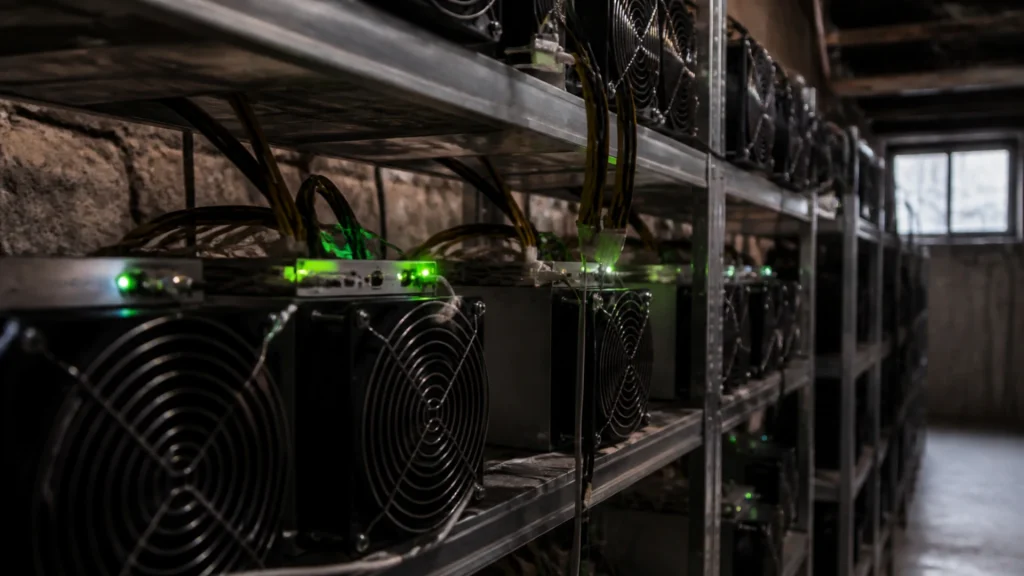
Crypto mining tax in France
BNC income according to the BOFiP
Commentary BOI-RPPM-PVBMC-30-10 expressly covers the activity known as “mining”. It classifies as BNC the remuneration received by the taxpayer for taking part in the creation or operation of the system. The impots.gouv.fr page on digital assets adopts the same solution. It states that profits from mining are taxed in the BNC category.
Micro-BNC or the actual-expenses regime
For crypto transactions taxed as BNC, impots.gouv.fr mentions two regimes. The first is micro-BNC, with a 34% allowance. The second is the actual-expenses regime (déclaration contrôlée), which takes actual costs into account. The site adds that these profits bear the progressive income tax scale and social levies. It cites these regimes in relation to transactions similar to a professional activity, without detailing them for mining. The weight of your actual costs, hardware and electricity in particular, will guide the analysis.
Take an example calculation, assuming micro-BNC applies. Mining receipts of €3,000 give, after the 34% allowance, taxable profit of €1,980. This amount is added to your other income subject to the progressive scale. With €1,200 of documented actual costs, the actual-expenses regime would result in €1,800.
Reselling mined tokens
A miner who later resells the tokens carries out a second transaction, separate from the remuneration. If acting as a private individual, this disposal falls within the scope of Article 150 VH bis and Form 2086. The acquisition price of these tokens in the portfolio formula still has to be determined. The impots.gouv.fr page does not specify it, and this point deserves prior analysis.
Staking tax in France: an administrative position
Staking consists of locking up tokens to take part in validating a blockchain, in return for remuneration in tokens. No statutory text covers it, and the BOFiP does not comment on it.
The official source available is a sentence published on impots.gouv.fr, on a page updated on 17 July 2026. It states (our translation): “Profits from mining or staking activities are taxed in the category of non-commercial profits (BNC).” This is the tax authority’s position on its website, not a statutory rule.
The stakes are concrete. BNC income is added to your other income and bears the progressive scale, together with social levies. An occasional capital gain on disposal bears an overall rate of 31.4% in 2026. Depending on your tax bracket, the difference may work one way or the other.
This position calls for three remarks. The page does not distinguish between direct staking, delegation to a validator and staking offered by a platform. It specifies neither when rewards are taxed nor how they are valued. Nor does it deal with the later resale of the tokens received. You should therefore keep a precise register of your rewards: date, quantity, euro price and platform used.
NFT tax: the new Article 150 VH ter of the CGI
Article 91 of Law no. 2026-534 of 25 June 2026 created Article 150 VH ter of the CGI. It applies to disposals made from 1 January 2026. It covers unique and non-fungible crypto-assets, within the meaning of Article 2(3) of the MiCA Regulation, and related rights.
The principle is simple to state. Gains on disposals for consideration of these NFTs are taxable “under the regime applicable to the goods or rights they represent” (our translation). The text reserves the provisions specific to business profits.
The second paragraph settles a specific case. Where the NFT represents an asset covered by paragraph I of Article 150 VI, that article applies. This concerns precious metals, as well as jewellery and works of art, collector’s items or antiques. Their disposal then falls under the flat-rate tax provided for by Articles 150 VJ to 150 VM.
Everything therefore turns on the classification of the asset represented. An NFT backed by a physical work of art does not raise the same question as a purely digital token. For the latter, the text does not designate a default regime. The NFT’s documentation must be analysed before the disposal.
Where the NFT is held also matters. Article 1649 bis C of the CGI requires NFTs held or used abroad to be declared. Omission costs €750 per NFT, under Article 1736, X, of the CGI.
Where is the boundary with professional activity?
Item 1° bis of paragraph 2 of Article 92 of the CGI covers income from transactions involving the purchase, sale and exchange of crypto-assets. It taxes them as BNC where they are carried out under “similar conditions” to those of a person who carries out such transactions professionally. This rule stems from Article 70 of Law no. 2021-1900 and has applied since 1 January 2023.
Another boundary exists. According to impots.gouv.fr, purchases and resales linked to a commercial activity, within the meaning of Article L. 110-1 of the French Commercial Code (Code de commerce), fall under industrial and commercial profits (BIC). The BOFiP also links to BIC the habitual activity of buying crypto-assets for resale.
The text sets no numerical threshold. The classification is assessed in the light of the actual conditions of your transactions. Our article on the professional crypto trader looks at this question in detail.
Summary of the applicable regimes
| Transaction | Tax treatment | Legal basis |
|---|---|---|
| Occasional resale of fungible crypto-assets for euros, goods or a service | Gain taxed at 31.4% in 2026, or at the progressive scale on option (box 3CN) | Articles 150 VH bis and 200 C of the CGI |
| Exchange between crypto-assets without a balancing payment | Tax deferral | Article 150 VH bis, II, A, of the CGI |
| Mining | BNC | BOI-RPPM-PVBMC-30-10; impots.gouv.fr |
| Staking | BNC according to the tax authority | impots.gouv.fr; no statutory text or BOFiP |
| Disposal of an NFT since 1 January 2026 | Regime of the goods or right represented | Article 150 VH ter of the CGI |
| Transactions similar to those of a professional | BNC | Article 92, 2, 1° bis, of the CGI |
| Buying and reselling as part of a commercial activity | BIC | impots.gouv.fr; BOFiP |
For occasional resales, the calculation goes through Form 2086, which we explain line by line.
Supporting documents to keep
In the absence of a precise text for staking, the quality of your supporting documents will carry great weight if the tax authority raises questions. At a minimum, keep:
- the date, quantity and euro price of each mining or staking reward;
- hardware and electricity invoices relating to mining;
- the terms and conditions of the staking service used;
- for each NFT, the documentation describing the goods or right represented.
Article 1649 AC bis of the CGI requires crypto-asset service providers to report their users’ transactions carried out since 1 January 2026. The first report will take place in 2027. Your own records must therefore match this data.
How the firm assists you
Mining, staking and NFTs often combine several regimes for the same taxpayer. A crypto tax lawyer classifies each flow, chooses the appropriate form and documents the positions taken. Maître Arnaud Touati and the firm’s team assist you in this analysis. Every situation is different, especially when the rule rests on a mere administrative position.
FAQ on staking and mining tax in France
Are staking rewards taxed as capital gains?
No, according to the tax authority. The impots.gouv.fr website states that staking profits are taxed as BNC. To date, no statutory text or BOFiP commentary confirms this position.
Is mining carried out in a personal capacity taxable?
Yes. The BOFiP classifies as BNC the remuneration corresponding to participation in the creation or operation of the system. The texts cited here provide for no exemption threshold specific to mining.
How is the resale of an NFT taxed in 2026?
Since 1 January 2026, Article 150 VH ter applies the regime of the goods or right represented by the NFT. If the asset is jewellery or a work of art, the flat-rate tax of Article 150 VI applies.
When do my transactions become professional?
Article 92 of the CGI sets no threshold. It covers transactions carried out under conditions similar to those of a professional, which is assessed case by case.
Official sources
- Article 150 VH bis of the French Tax Code (Code général des impôts), gains on crypto-assets made by individuals – Légifrance (in French)
- Article 150 VH ter of the French Tax Code (Code général des impôts), disposals of unique and non-fungible crypto-assets – Légifrance (in French)
- Article 150 VI of the French Tax Code (Code général des impôts), flat-rate tax on precious metals, jewellery and works of art – Légifrance (in French)
- Article 92 of the French Tax Code (Code général des impôts), 2, 1° bis, professional transactions in crypto-assets – Légifrance (in French)
- BOI-RPPM-PVBMC-30-10, scope of the regime and mining activity – BOFiP-Impôts (in French)
- “Comment déclarer les plus ou moins-values sur cessions d’actifs numériques ?” (How do I declare gains or losses on disposals of digital assets?), page updated on 17/07/2026 – impots.gouv.fr (in French)
This article sets out the law verified as at 5 October 2026 for general information purposes. It does not constitute legal advice. Every situation is different and deserves a dedicated analysis.

