

Law verified as at 5 October 2026
The rules cited in this article are those in force on that date. They may change, in particular with the Finance Act for 2027.
The exit tax is not a departure penalty. It is the taxation, when your tax domicile is transferred outside France, of capital gains that have not yet been realised. The key mechanism is not the rate but the deferral of payment: in most departures to the European Union, nothing is paid on departure, and the tax is cancelled after two or five years. You still need to file the right returns on time.
The full process of a departure, of which the exit tax is only one step, is described on our page making a change of residence legally sound.
Who is affected by the French exit tax?
Article 167 bis of the French Tax Code (code général des impôts, CGI) sets two cumulative conditions.
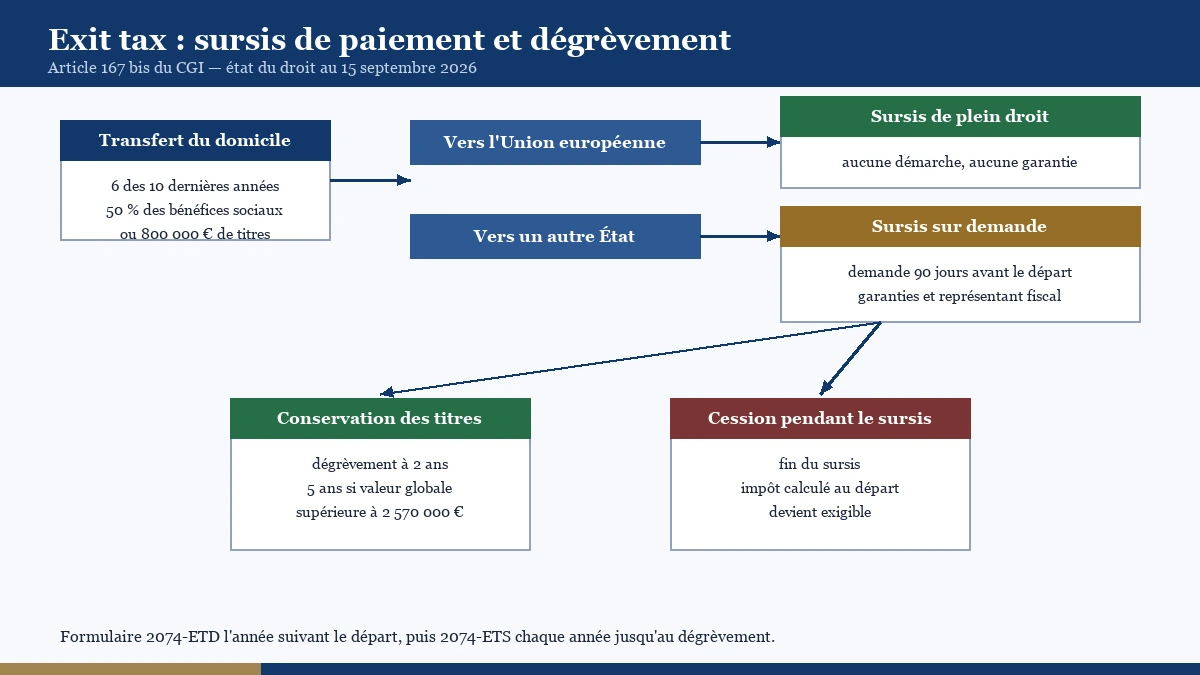
- A duration condition: having been tax domiciled in France for at least six of the ten years preceding the transfer of domicile.
- A threshold condition: holding, directly or indirectly, company shares or securities representing at least 50% of a company’s profits, or whose total value exceeds €800,000 on the date of the transfer.
The €800,000 threshold is assessed on all the holdings of the tax household, not company by company. Below both thresholds, Article 167 bis does not apply, but you still need to deal with the other consequences of leaving: evidence of the transfer of domicile, property kept in France, tax returns for the year of departure.
Which capital gains are covered
Three categories fall within the tax base.
- Unrealised capital gains on company shares, securities, instruments or rights held on the date of the transfer. They are calculated as the difference between the value of the shares on that date and their acquisition price.
- Receivables arising from an earn-out clause (complément de prix), where an earlier sale provided for one.
- Rolled-over capital gains (plus-values en report d’imposition), whose taxation had been postponed, in particular under a contribution-and-sale arrangement (apport-cession) falling under Article 150-0 B ter of the CGI.
Tax is assessed at the flat rate of 12.8% provided for in Article 200 A of the CGI, with the option for the progressive income tax scale remaining open, plus social levies. Rolled-over gains under Article 150-0 B ter follow a rate rule of their own.
Deferral of payment: automatic or on request
This is where the key issues lie.
Automatic deferral applies when the taxpayer transfers their domicile to a Member State of the European Union, or to a State or territory that has concluded with France an administrative assistance agreement to combat tax fraud and tax evasion and a mutual assistance agreement on tax recovery, with a scope comparable to that of Directive 2010/24/EU, and that is not a non-cooperative State or territory. No prior formality and no security are required: the tax is assessed but its payment is suspended.
Deferral on request concerns other destinations. It requires an express request, the appointment of a tax representative and the provision of security to ensure recovery of the tax. For transfers made since 22 November 2019, this request must be filed no later than ninety days before the transfer, with a proposal of security. A late request means losing the benefit of the deferral.
When is the tax discharged?
The deferral is not just a cash-flow facility: it leads to a discharge if the shares are kept.
- Two years after the transfer, where the shares are still among the taxpayer’s assets.
- Five years where the total value of the shares exceeds €2,570,000 on the date of the transfer.
Three other events also trigger a discharge: the taxpayer’s death, a gift of the shares and a return of the domicile to France. A gift only triggers a discharge unconditionally if the donor resides in a State that qualifies for automatic deferral; elsewhere, the donor must show that the main purpose of the gift is not to avoid the tax. On a return, the person is placed back in the tax position they would have been in had they never left the country, as regards the taxation of those shares.
Conversely, the sale, buy-back, redemption or cancellation of the shares during the monitoring period ends the deferral: the tax calculated on departure becomes payable.
The returns to file
| Form | Purpose | Deadline |
|---|---|---|
| 2074-ETD | Return of unrealised capital gains, earn-out receivables and rolled-over capital gains | The year after departure, with the income tax return. For deferral on request, no later than 90 days before the transfer, together with the proposed security |
| 2074-ETS | Annual monitoring of the deferred tax | Every year while the deferral runs, until the discharge |
The annual monitoring return is too often overlooked. Failing to file it exposes the taxpayer to the deferral being challenged, even though the shares have not been sold.
A worked example
A founder holds 62% of a company’s share capital, valued at €3,100,000 on the day she leaves. Her acquisition price is €250,000. She has been domiciled in France for fifteen years and is moving to Spain.
- Tax base: unrealised capital gain of €2,850,000. Both conditions are met, as the holding exceeds 50% of the company’s profits.
- Tax assessed: €2,850,000 × 12.8% = €364,800 in income tax, plus social levies.
- Payment on departure: zero. As Spain is a Member State of the European Union, the deferral applies automatically, with no security or prior request.
- Discharge: the total value of the shares, €3,100,000, exceeds €2,570,000. The period is therefore five years, not two.
- If she sells after three years: the deferral ends and the tax of €364,800 becomes payable, subject to the correction mechanisms provided for where the sale value is lower than the value used on departure.
The same departure to a State that does not qualify for automatic deferral would have required a deferral request filed no later than ninety days before the transfer, with security provided.
Can you “avoid” the French exit tax?
The question comes up in almost every search on the subject. The legal answer comes down to three verbs, and none of them is “avoid”.
- Defer: this is the purpose of the deferral, followed by the discharge after two or five years. For a long-term move within the European Union, the exit tax leads to no payment if the shares are kept for that period.
- Purge: gifting the shares before leaving removes them from the donor’s assets: they no longer fall within the exit tax base, and the donee receives them at their value on the date of the gift, subject to gift duties. After departure, a gift of shares under deferral triggers a discharge under the conditions set out above. The comparative calculation is developed in our article: purging the unrealised capital gain.
- Comply: file the 2074-ETD, then the annual 2074-ETS returns. It is the failure to file, more than the amount, that turns a deferral into a debt that is payable.
A sham domicile intended to escape this tax is not an option. A fictitious tax domicile abroad is an aggravating circumstance of tax fraud within the meaning of Article 1741 of the CGI, punishable by seven years’ imprisonment and a €3,000,000 fine.
What the Finance Act for 2026 changed, and what it did not
Nothing, on this regime. Law No. 2026-103 of 19 February 2026 did not amend Article 167 bis, whose version in force dates back to 1 January 2024. Changes envisaged for the future are tracked in our dated review of proposals (in French).
Key points
- Two cumulative conditions: six years of domicile out of ten, and 50% of the company’s profits or more than €800,000 of shares.
- To the European Union or a State linked to France by equivalent assistance agreements, the deferral is automatic and no payment is due on departure; elsewhere, the request is filed 90 days before the transfer.
- The discharge occurs after two years, or after five years above €2,570,000 of shares, provided the monitoring return has been filed every year.
The exit tax is only one part of leaving: tax residence, assets kept in France, estate planning. Our firm of tax lawyers in Paris reviews the whole picture before the date of the transfer.
Frequently asked questions
Who is affected by the French exit tax?
People domiciled in France for at least six of the ten years before their departure who hold shares representing at least 50% of a company’s profits or with a total value of more than €800,000.
How does the deferral of payment work?
It suspends payment of the tax assessed on departure. It applies automatically for a move to a European Union State or to a State linked to France by assistance agreements equivalent to Directive 2010/24/EU. Elsewhere, it requires a request, a tax representative and security.
How is the exit tax calculated?
The base is the difference between the value of the shares on the date of the transfer and their acquisition price. The rate is 12.8% in income tax, with the option for the progressive scale, plus social levies.
Which form must be filed, and when?
The 2074-ETD the year after departure, with the income tax return. For deferral on request, it is filed no later than 90 days before the transfer, with the proposed security. The 2074-ETS then provides the annual monitoring.
Has the exit tax been abolished?
No. The regime was adjusted in 2019, in particular as regards the length of the monitoring period, but it remains in force under Article 167 bis of the CGI.
What happens if I come back to France?
Moving the domicile back to France triggers a discharge where the shares are still among the taxpayer’s assets. The taxpayer is placed back in the position they would have been in had they never left, as regards the taxation of those shares.
Preparing your departure
The real cost of leaving depends on the order of the steps and on meeting filing deadlines. We cost the options, prepare the 2074-ETD and handle the follow-up until the discharge. See our page tax expatriation lawyer in Paris and our article on tax returns for the year of departure. Every situation is different and deserves a dedicated analysis.
Official sources
- Article 167 bis of the French Tax Code, taxation of unrealised capital gains on transfer of domicile outside France – Légifrance (in French)
- Article 200 A of the French Tax Code, 12.8% flat rate – Légifrance (in French)
- Article 150-0 B ter of the French Tax Code, rolled-over capital gains – Légifrance (in French)
- Article 1741 of the French Tax Code, tax fraud and aggravating circumstances – Légifrance (in French)
- French Public Finances Directorate (DGFiP), page (“Je quitte la France, suis-je concerné par l’exit tax ?”, i.e. I am leaving France: does the exit tax apply to me?) updated on 10 March 2026 – impots.gouv.fr (in French)
- Law No. 2026-103 of 19 February 2026 (Finance Act for 2026) – Légifrance (in French)
This article sets out the law for general information purposes, as verified on the date of publication. It does not constitute legal advice. Every situation is different and deserves a dedicated analysis. Content compliant with the professional conduct rules of the legal profession.

