


Law checked as at 5 October 2026
The rules cited in this article are those in force on that date. They may change with the Finance Act for 2027 and after the 2027 presidential election. We distinguish between the law in force, texts under discussion and manifesto proposals.
An election does not change any tax rule. Only a promulgated law does, and the 2027 finance bill must be tabled by 6 October 2026 at the latest, well before the vote. The useful question is therefore not whether to leave before 2027, but which rules apply today, which ones may change, and from what date a decision takes effect.
The full legal framework for a departure, step by step, is set out on our page on support with a change of tax residence.
What does an election really change for a taxpayer?
Nothing, in itself. Tax law derives from texts passed by Parliament and promulgated. A campaign manifesto is neither a bill nor a rule: it creates no rights and imposes no obligations.
What an election changes is the timetable of the texts. The 2027 finance bill (projet de loi de finances) must be tabled by the first Tuesday of October 2026 at the latest, i.e. 6 October (Article 39 of the Organic Law on Finance Laws (loi organique relative aux lois de finances) (in French)). This text, debated under the current legislature, will contain the tax measures applicable in 2027. The positions defended during the spring 2027 campaign could only be translated into legislation afterwards, in a new text passed by Parliament.
What is in force, what is under discussion, what is proposed
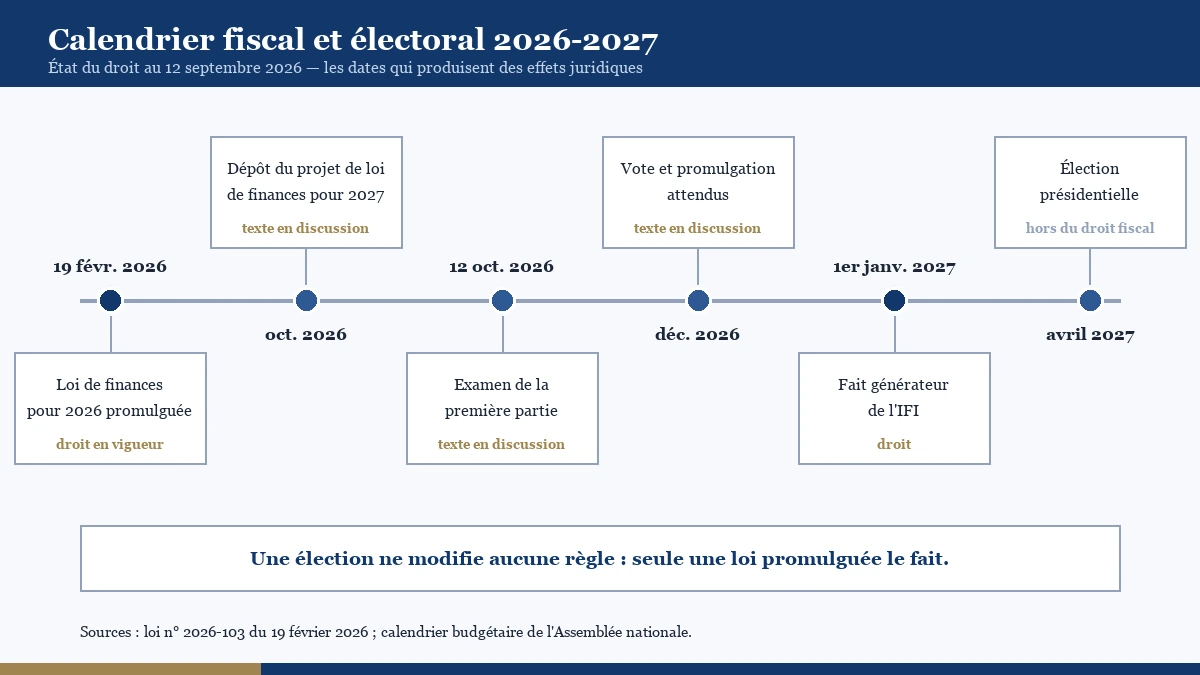
Three levels that must never be confused.
| Level | Example | Legal effect |
|---|---|---|
| Law in force | Law No. 2026-103 of 19 February 2026 (Finance Act for 2026): 20% tax on the non-business assets of certain holding companies, individual retention commitment under the Dutreil pact (pacte Dutreil) extended to six years, 70% reinvestment requirement in contribution-and-sale transactions (apport-cession) | Applicable and enforceable |
| Law in force | Exit tax under Article 167 bis of the French Tax Code (code général des impôts, CGI), version in force since 1 January 2024 (Law No. 2023-1322 of 29 December 2023) | Applicable and enforceable |
| Text under discussion | Finance bill for 2027, to be tabled by 6 October 2026 at the latest | None, as long as it is neither passed nor promulgated |
| Manifesto proposal | Minimum tax of 2% on wealth above €100 million, advocated in the public debate and not adopted to date | None |
We keep a dated and sourced record of the announced measures in our table of announced measures (in French).
Can a Finance Act apply to the current year?
On this point, the answer depends on the chargeable event (fait générateur) of the tax.
For income tax, the chargeable event occurs on 31 December: the tax is due on the income realised or available during the year (Article 12 of the CGI (in French)). A law passed in December 2026 can therefore change the rules applicable to income received since 1 January 2026. This practice is called “minor retroactivity” (petite rétroactivité). The Constitutional Council (Conseil constitutionnel) sets limits on it: without a sufficient general-interest ground, the legislature may neither undermine legally acquired situations nor call into question the effects that may legitimately be expected from such situations (Decision No. 2013-682 DC of 19 December 2013).
This power has a limit. In its Decision No. 2012-662 DC of 29 December 2012, the Constitutional Council struck down the provision of the Finance Act for 2013 that retroactively removed the discharging (libératoire) effect of the flat-rate withholdings already paid on 2012 investment income: the aim of securing additional revenue did not constitute a sufficient general-interest ground.
For the real estate wealth tax (impôt sur la fortune immobilière, IFI), liability is assessed on 1 January of each year (Article 964 of the CGI). Tax on a real estate capital gain is paid on the sale (Article 150 VF of the CGI (in French)). A capital gain on shares, by contrast, falls under income tax for the year of sale: a law passed in December can still apply to it. The full reasoning is set out in our analysis of legal certainty in tax matters (in French).
How long does leaving France take, legally?
A change of tax residence cannot be decided in a few weeks. Allow twelve to eighteen months between the first review and a documented departure.
- Three to six months for the inventory of assets, the reading of the applicable tax treaty and the costing of the options.
- Three to nine months for the preparatory steps: reorganisation of shareholdings, any gift, decisions on real estate, documented letting of the home you keep.
- The departure date itself, which triggers the exit tax and splits the tax year.
- Ninety days before the transfer, at the latest, for the request for a payment deferral when moving to a State not eligible for the automatic deferral (Article 41 tervicies A of Annex III to the CGI (in French)).
- Two to five years afterwards for monitoring the deferral until the discharge, and keeping the evidence file.
Tax domicile is not declared; it is established by the facts. The criteria of Article 4 B of the CGI (home (foyer), principal place of stay, professional activity, centre of economic interests) govern everything: we set them out in detail in our article on the conditions for French tax residency.
Who should look into the question?
Three situations justify a review, regardless of the political context.
Holders of shares with a large unrealised capital gain. The exit tax under Article 167 bis targets persons domiciled in France for six of the previous ten years who hold shares representing at least 50% of a company’s profits or with an overall value above €800,000.
Property owners. Leaving does not take a French property out of the IFI or out of the levy on real estate capital gains.
People whose family stays in France. Having your home in France is enough to be domiciled there, however long you are present. Leaving alone while your spouse and children remain in Paris has, in most cases, no effect on your tax domicile.
A worked example
A company director holds shares valued at €4,000,000, with an acquisition cost of €1,000,000. The unrealised capital gain is €3,000,000. He has been domiciled in France for more than ten years.
- He sells before leaving. The €3,000,000 gain is taxed at the 12.8% flat rate under Article 200 A of the CGI, i.e. €384,000, plus social levies and, where applicable, the exceptional contribution on high incomes (contribution exceptionnelle sur les hauts revenus, Article 223 sexies of the CGI). The tax is paid under the ordinary rules, with no deferral possible.
- He moves to a European Union State and keeps his shares. The exit tax is assessed on the same base, but the payment deferral applies automatically: no cash outlay on departure. As the overall value of the shares exceeds €2,570,000, the discharge occurs after five years of holding.
- He leaves, then sells after two years. The deferral ends and the tax calculated on departure becomes payable.
The comparison does not settle anything on its own. It shows that the order of the transactions matters more than the date of departure.
Key points
- An election changes no rule: only a promulgated law does. The 2027 finance bill must be tabled by 6 October 2026 at the latest, before the vote.
- A transaction completed in 2026 is not protected from a law passed in December: everything depends on the chargeable event specific to each tax.
- A documented change of residence takes twelve to eighteen months: haste creates the risk, not the saving.
FAQ
Should you leave France before the 2027 election?
No rule attaches any advantage to that date. What counts is the chargeable event of the tax concerned and the date on which a transaction is legally completed. A departure decided to meet a political deadline is hard to document and easy to challenge.
Can a new law tax a transaction already carried out?
For income tax, a law passed in December can apply to the income of the current year, including capital gains on shares. However, in 2012 the Constitutional Council struck down the reversal of a discharging withholding tax already paid, for lack of a sufficient general-interest ground. Tax on a real estate capital gain, for its part, is paid on the sale.
What level of wealth justifies looking into a departure?
The thresholds of Article 167 bis provide a benchmark: more than €800,000 in shares or a holding of at least 50% of a company’s profits. Below that, the exit tax does not apply, but the IFI and real estate taxation may justify an analysis.
Can you leave and then come back?
Yes. Returning to France results in the discharge of the exit tax where the shares are still among your assets. A quick round trip, however, weakens the evidence that your domicile has genuinely moved.
Have your situation analysed
We cost each option in the light of the law in force on the day of the review, and we indicate what calls for an immediate decision and what can wait for the text as passed. The full process is described on our page on the legal framework for tax expatriation. If you are not considering leaving, see deciding before the budget vote (in French).
Official sources
- Law No. 2026-103 of 19 February 2026 (Finance Act for 2026) – Légifrance (in French)
- Article 4 B of the French Tax Code (code général des impôts), tax domicile – Légifrance (in French)
- Article 167 bis of the French Tax Code (code général des impôts), exit tax – Légifrance (in French)
- Article 200 A of the French Tax Code (code général des impôts), 12.8% flat rate – Légifrance (in French)
- Article 964 of the French Tax Code (code général des impôts), real estate wealth tax – Légifrance (in French)
- Constitutional Council (Conseil constitutionnel), Decision No. 2012-662 DC of 29 December 2012 – conseil-constitutionnel.fr (in French)
- Constitutional Council (Conseil constitutionnel), Decision No. 2013-682 DC of 19 December 2013 – conseil-constitutionnel.fr (in French)
This article presents the state of the law for general information purposes, checked at the date of publication. It does not constitute legal advice. Every situation is different and deserves a dedicated analysis. Content compliant with the ethical rules of the legal profession.

